
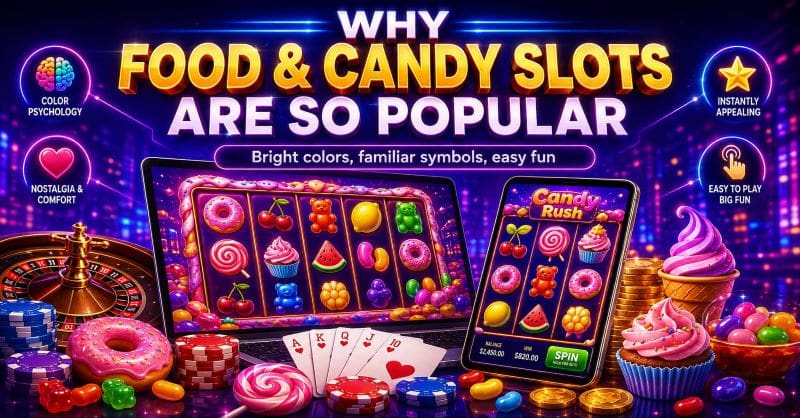
Casino websites have hundreds of video slots to choose from, and the number of fruit slot titles available exceeds ten. If you begin counting how many of the slot titles at casinos include a cherry, doughnut, or gummy bears, it will not be long until you reach ten. Slots based on food and candies with bright colors represent one of the most successful formats in the casino industry. Once you begin examining the factors contributing to this success, you cannot help but notice it.
These are not merely design choices regarding color and style. Rather, the combination of color, memory, and simplicity represented by the majority of today’s slots represents a very effective method of creating a theme for a slot machine that appeals to a large number of players for extended periods of time. In my efforts to learn more about how people interact with video slot machines – both online and live in a casino environment — I have noticed a strong trend in favor of bright colors and food themes.
When comparing a video slot featuring a dark, ominous theme versus a slot featuring colorful fruits and foods, casual players consistently select the brighter option. Casual players do not perceive the dark themed slot as less enjoyable than the bright colored slot. Instead, they perceive the dark slot as requiring more effort prior to beginning to enjoy playing. Thus, this is effectively the complete explanation for this phenomenon, but it is worthwhile to analyze further in order to illustrate that the reasoning is more complex than simply stating “the bright colors are attractive.”
Color psychology behind candy slot games
Color psychology related to candy-based slot games is not simply a marketing term created to promote products. Red, orange, and yellow colors stimulate arousal, attract focus more quickly than green or blue colors, and are reminiscent of ripe fruit, cooked food, and most fast-food brands. Consider how many fast-food logos utilize red and yellow colors. This is not an accident; it utilizes the same visual stimulus that slot game manufacturers rely upon when developing slots around cherries, watermelons, and jellybeans. Additionally, brightly colored slots provide an additional benefit to players in regard to making the game easier to view during short intervals of time.
For example, a cascading reel filled with contrasting colors (i.e., a blue raspberry candy adjacent to a yellow lemon adjacent to a red strawberry), provides immediate separation of symbols through visual cues. Conversely, consider a slot built around ancient runes etched in stone, where all symbols are approximately the same shade of grey-brown. Players must squint to distinguish between symbols viewed on a mobile device. Brightly colored palettes resolve a significant usability issue while providing a desirable appearance. Two birds, one bag of gummies.
Additionally, there is an association with warmth that relates to color and has proven importance. Warm colors (red, orange, pink) are associated with comfort, energy, and appetite in numerous studies related to consumer psychology. Cool colors are typically interpreted as calm or clinical. A slot featuring ice cream sundaes and red velvet cake appears as though it is offering the player a visual representation of a warm hug.
This concept is important as it pertains to how a player perceives his/her self-viewed interaction with a product (in this case a video slot). Since players who perceive themselves as comfortable and happy while interacting with a product will likely spend more time viewing/interacting with that product than players who perceive themselves as uncomfortable/unhappy; this relationship illustrates an essential aspect of video slot development.
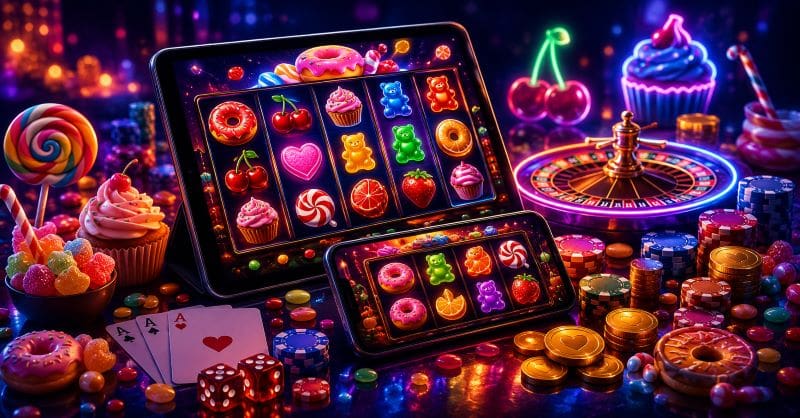
Why food-themed slots work well when everything else is removed
This section took me some time to fully grasp; however, once I did, I realized food-themed slots appeal due to removing nearly all barriers between the player and the game. Remove the reels and pay table for a brief period and think about what a “theme” truly offers. It provides mood, tone, and stakes immediately for a player who may not speak/read the language in which the game was developed. A cherry provides this information immediately. Similarly, a piece of pizza, taco, cup of coffee or lollipop do as well.
You do not need tutorials to determine what type of pastry a doughnut is. Compare this to video slots with themes such as Norse mythology or a specific historical event; both require the player to either previously be aware of the referenced material or accept unfamiliarity prior to the symbols in the game having any significance. Universal references to food eliminate this barrier completely. There is no requirement for players to possess any level of cultural literacy in order to recognize a slice of watermelon. It is in this area that cross-culturally acceptable food symbols demonstrate great value.
Ripe fruit (such as grapes) conveys virtually the same message in Lisbon as it does in Bangkok: sweet, fresh, slightly indulgent. A chocolate bar signifies a treat throughout nearly all areas of the world where sugar is sold. Video game companies targeting global audiences know this intuitively; therefore, many of their food-based library entries combine staple fruits (grapes, lemons, watermelons) with recognizable candies (lollipops, jellybeans, gummies) and occasionally include savory dishes such as sushi or tacos for localized flair.
The vast majority of symbols present no language barrier whatsoever; this is relatively uncommon in game design. Accessibility is another factor contributing to why food-themed slots perform exceptionally well across age groups and skill sets; a twenty-two-year-old using her smartphone and grandma using her computer-based physical slot machine are unexpectedly attracted to the same bowl of candy for similar reasons.
Emotional pull nobody discusses enough
There exists an additional psychological component beyond “it looks nice” and “it’s easy to understand.” Food elicits an emotional response that many other slot themes fail to achieve. The overwhelming majority of childhood memories relating to candy are virtually universal: corner stores, birthday cakes, flavors of gummy bears that were always selected first. Video game developers who create content around nostalgic memories associated with desserts and comfort foods tap directly into this repository of collective consciousness.
While developers may not describe it as such in their design documents, this is an emotionally charged appeal that contributes significantly to positive emotional connections with an experience. Positive emotional associations influence perceptions of risk. A slot built on candy and desserts creates feelings of reduced risk and a friendly atmosphere preceding each spin; primarily because the imagery associated with pleasure rather than tension. This establishes a fundamentally different initial emotional perspective compared to a slot centered around a horror movie or war campaign. Positive pleasure/reward associations exist within the visuals prior to engaging with game mechanics; this encourages players toward relaxation and enjoyment rather than stress and anxiety.
In addition to the pleasure/reward connection, sensory satisfaction is provided by slots in general; particularly those depicting edible treats. Visual stimulation from seeing walls of chocolate, ice cream, and jellybeans cascading down the screen activates a neural reward pathway similar to consuming dessert; except for the caloric intake. This is an activation of a primitive drive; albeit innocuous alone; yet explains why players find satisfaction in viewing these types of slots even if wins are modest. The visual rewards do an immense amount of emotional work on their own.
Bright themes in candy slots serve both mechanics & eyes
Much like many casual observers underestimate the value added by vibrant visuals in modern slot games, the impact that bright visuals contribute to functional aspects of gameplay far exceeds mere aesthetics; they are directly correlated with how modern slot mechanics operate. As mentioned earlier; food-themed slots’ visual design serves multiple purposes, including functionality. That is much easier when each symbol presents highly contrasted colors instead of muddled variations of brown/grey. Cluster-pays slots (where any grouping of matching symbols on the grid counts toward winning combinations regardless of position) rely heavily on high-contrast symbols; thus cluster wins can be easily recognized as soon as they occur visually via high-contrast colors.
Food-themed slots also contain layers related to collecting mechanics and ingredient collection bonuses where players collect specific food items over consecutive spins to activate bonus rounds; often visually representing ingredients being collected on-screen and forming recipes or completing candy jars. Collecting mechanisms only function clearly when each item has distinct, recognizable characteristics (color) – which is where color psychology plays again. An example illustrating this point includes a cooking-themed bonus round where players collect tomatoes, basil leaves and mozzarella cheese to “create” a pizza; this visual mechanism only functions because no ambiguity exists between distinguishing tomatoes from chilies peppers.
Sweet treat multipliers and dessert jackpot features follow similar logic related to rewarding visually distinct symbols; such as multipliers depicted as giant swirls of frosting or stacks of pancakes provide better retention for players than generic “multiplier x3” icons ever could; providing clear recognition during prolonged gaming sessions.
Several examples make it easy to identify commonality among various sectors within this genre: Sweet Bonanza and its many clones utilize jellybeans, lollipops and fruit within fast-paced visual feedback structures utilizing cascading reels (e.g., tumble-reels). Classic seven-and-cherry games continue dominating low volatility categories; although dated decades ago – still remain instantly understandable due to their established symbol sets. Bakery/dessert-themed cluster-pays utilize cakes/doughnuts as high-paying symbols specifically because they remain visually distinct against other elements on the reel.
Regional food-themed cluster-pays incorporating sushi/tacos/curry extend this approach into regionally-specific comfort food for targeted demographics.
Fruit machines to candy-land: evolution vs fad
Early mechanical slots utilized fruit-based symbols primarily due to their association with early gum promotional materials dating over one hundred years ago; and subsequent longevity was due solely because they proved successful as opposed to developers finding alternative designs. What transpired subsequently amounts to evolutionary growth rather than creation anew: fruit machine cherries-lemons have evolved into elaborate candylands-desserts-restaurants-food trucks etc.; however fundamental attributes have remained unchanged.
This similarity underscores why candy-slot popularity is not an enigma worthy of extensive discussion: candy-slot design continues serving fundamental design objectives: creating screens full of spinning symbols as exciting/clear/enjoyable views for global/mixed-experience player bases – simultaneously without tutorials – and food has been answering all three queries simultaneously.
Limitations of format
It is imperfect, and it should be acknowledged accordingly. The variety offered by food-themed slots eventually becomes difficult to discern – once you’ve played 10+ candy-cluster slots – novelty wears off rapidly; because visual vocabulary employed by candy-cluster-slots is limited compared to virtually limitless thematic options available within fantasy/adventure genres possessing unlimited lore potential. Premium status achieved by slots built around licensed film properties with cinematic-style bonus animations are inherently precluded when building around jellybeans instead.
There is also legitimate discussion surrounding food/candy images potentially appealing more towards younger-skewed segments – despite games being developed for age-limited adults in regulated environments. Regardless of theme; responsible gaming guidelines applicable to virtually all jurisdictions regulate age verifications and clearly define terms; and reputable developers/operators develop their games adherent thereto – yet image similarities between candy-slots and mobile puzzle games targeting youth are undeniable.
Despite those limitations, underlying principles hold true: brightly-saturated colors; universally recognizable symbols; and mechanics emphasizing rapid visual processing – represent effective methodologies designed to satisfy requirements inherent within initial 10-second interactions between slot-machines/player-viewership – are not arbitrary design preferences.